Dog Groomer SEO: The 5 Pages Every Salon Website Needs to Rank
Most grooming websites have 3 pages: a homepage, an "about" page nobody reads, and a contact page. Then owners wonder why they don't rank. Google needs more than that to understand what you do, where you do it, and why someone should choose you over competitors.
Here are the 5 pages that actually move the needle for local grooming SEO.
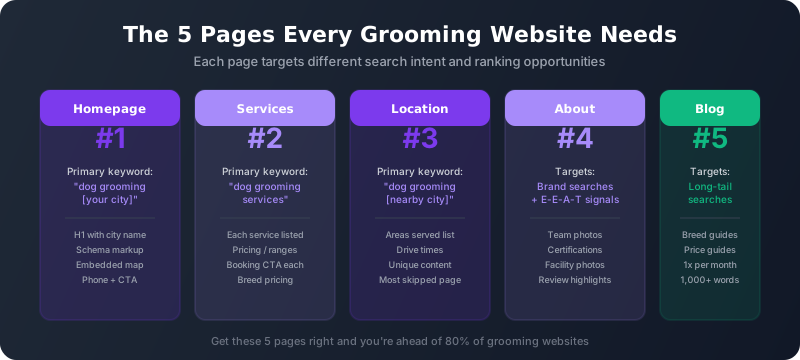
1. Homepage: Your Most Important Page
Your homepage carries the most authority and should target your primary keyword: "dog grooming [Your City]" or "dog groomer [Your City]".
What it needs:
- H1 headline with your city and "dog grooming" — e.g., "Professional Dog Grooming in Scottsdale, AZ"
- 50-100 words of intro text above the fold mentioning your services and location naturally
- Service list — even a brief one signals to Google what you offer
- Your address in the footer or a visible section (matches your Google Business Profile)
- Embedded Google Map — reinforces your location to search engines
- Phone number — clickable on mobile
- Schema markup — LocalBusiness structured data with name, address, phone, hours, services
Common mistakes:
- Hero image with no text (Google can't read images for keywords)
- Generic copy like "Welcome to our salon!" instead of keyword-rich intro
- No mention of city/area anywhere on the page
2. Services Page: What You Actually Do
A dedicated services page targets mid-funnel keywords like "dog grooming services," "dog bath and nail trim," and "puppy grooming."
What it needs:
- Individual sections for each service (full groom, bath & brush, nail trim, teeth cleaning, deshedding, puppy's first groom)
- Pricing or price ranges — pages with pricing rank better because they answer the searcher's question directly. Google rewards pages that satisfy intent.
- Brief descriptions of what's included in each service (2-3 sentences)
- Booking CTA after each service section
Pro tip: If you serve multiple breeds with different pricing tiers, include a breed-based pricing section. This creates natural keyword density for searches like "golden retriever grooming price" or "poodle grooming near me."
3. Location/Areas Served Page
This is the page most groomers skip entirely — and it's the easiest SEO win for multi-area targeting.
What it needs:
- H1: "Dog Grooming in [Primary City] and Surrounding Areas"
- List of neighborhoods/cities you serve with 2-3 sentences about each
- Drive time or distance from your salon to each area
- Unique content per area — not just a list of city names. Mention landmarks, neighborhoods, or zip codes.
This page lets you rank for "dog grooming [nearby city]" searches without creating dozens of thin doorway pages (which Google penalizes). One solid location page covering your service radius is better than 20 thin city pages with duplicate content.
Example structure:
"We're located in downtown Scottsdale, just off Camelback Road, and serve pet parents throughout the East Valley. Our clients come from Paradise Valley (5 min drive), Arcadia (10 min), Old Town Scottsdale (3 min), and as far as Fountain Hills (20 min). If you're within 15 miles of our salon, we'd love to see your pup."
4. About Page: Trust Signals
Your about page doesn't rank for service keywords — it ranks for your brand name and builds trust that converts visitors into clients.
What it needs:
- Your story — how long you've been grooming, why you started, certifications
- Team photos with names — people book with people, not logos
- Certifications and training — NDGAA, IPG, Fear Free, breed-specific training
- Facility photos — your actual space, not stock images
- Review highlights — pull 3-5 of your best Google reviews with star ratings
Google's E-E-A-T framework (Experience, Expertise, Authoritativeness, Trust) applies even to local businesses. An about page with real credentials, real photos, and real reviews signals to Google that you're a legitimate, trustworthy business.
5. Blog: Your Long-Term Traffic Engine
A blog isn't about posting cute dog photos (though those help social). It's about capturing long-tail search traffic that your service pages can't.
Blog topics that drive grooming traffic:
- "How often should I groom my [breed]?" — There are 200+ breed variations of this search
- "Dog grooming prices in [City] 2026" — Price comparison searchers often become clients
- "What to expect at your puppy's first grooming appointment" — New puppy owners are your best long-term clients
- "Signs your dog needs professional grooming" — Educational content that builds awareness
- "[Breed] grooming guide" — Golden Retriever, Poodle, Doodle, Shih Tzu each get 1,000+ monthly searches
Posting frequency:
One quality post per month is enough. Consistency matters more than volume. A 1,000-word article that answers a real question completely will outperform ten 200-word filler posts.
Need help building out these pages with proper SEO structure? We build groomer websites that rank.
Get a Free SEO AuditTechnical SEO Checklist
Beyond content, make sure these technical basics are in place:
- Page speed: Under 3 seconds on mobile (test at PageSpeed Insights)
- Mobile-responsive: Google uses mobile-first indexing — your mobile site IS your site
- SSL certificate: HTTPS is a ranking factor and a trust signal
- Google Business Profile: Claimed, verified, and linked to your website
- Consistent NAP: Name, Address, Phone identical everywhere (website, GBP, directories)
- XML sitemap: Submitted to Google Search Console
SEO for groomers isn't complicated — it's just methodical. Get these 5 pages right, keep your Google Business Profile active, and post one blog article per month. Within 6-12 months, organic search should be delivering 30-50% of your new clients at zero per-click cost.